
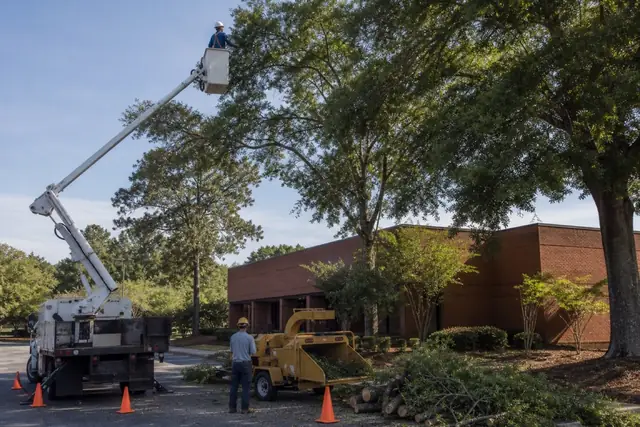
Macon Tree Experts connects Macon property owners with a local tree service provider for commercial tree care in Macon and nearby Middle Georgia communities.
Commercial tree care is an access and risk-management program as much as a pruning task. Parking occupancy, deliveries, pedestrians, tenant hours, lighting, signs, drainage, and emergency routes shape when and how work can happen. A useful inventory ranks trees by action instead of treating the property as one undifferentiated canopy.
Routine visits can address deadwood, sightlines, roof and light clearance, young-tree structure, mulch depth, irrigation conflicts, and changing defects. Larger removals and stump work can then be scheduled around business operations, while emergency contacts and access permissions are documented before a storm.
The scope should define traffic controls, exclusion zones, cleanup standard, notification responsibility, and how changes are approved. Multi-site owners also benefit from consistent tree identifiers and photographs so priorities can be compared across properties rather than rebuilt from memory at each visit.
Public movement shapes the work zone
OSHA's tree-care safety resources outline major hazards such as falls, struck-by exposure, equipment, and electricity. On an occupied property, the site plan must also keep customers, residents, and vehicles outside the drop and processing zones.
Macon-Bibb's visibility and nuisance provisions offer local context for blocked sightlines and hazardous vegetation. The property inspection still determines the exact clearance and tree response.
An inventory makes budgeting defensible
UGA Extension's shade and street tree guide covers pruning, roots, water, and mature-tree care. Turning those categories into an inventory—urgent defect, routine pruning, cultural care, monitor, or remove—keeps the budget tied to observed need.
The Georgia Forestry Commission's ordinance resource is useful when a portfolio crosses jurisdictions. Each work order should still confirm current city, county, utility, easement, and owner requirements for that address.
Further reading
Before the quote visit
Can commercial tree work be scheduled outside customer hours?
Often. Noise limits, lighting, access, disposal, and neighboring uses still need review, but phased or off-peak work can reduce conflicts.
What belongs in a commercial tree inventory?
A stable tree ID, species, location, size class, condition, defects, targets, recommended action, priority, photographs, and inspection date provide a useful baseline.
How are parking spaces protected during pruning?
The work plan sets a closure area, notification window, cones or barriers, equipment route, and branch-processing zone. Vehicle relocation must occur before work starts.
Can one proposal cover several managed properties?
Yes, but each site still needs its own access, tree inventory, jurisdiction, and schedule. A master format can make priorities and pricing easier to compare.
What storm preparation helps a commercial property?
Updated contacts, gate and roof access, utility information, tree identifiers, priority defects, and a clear authorization process speed triage after a storm.