
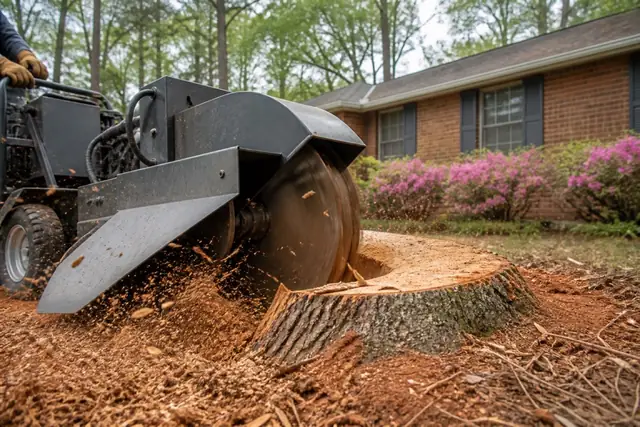
Macon Tree Experts connects Macon property owners with a local tree service provider for stump grinding in Macon and nearby Middle Georgia communities.
A stump quote should be tied to what happens next. A shallow grind can remove a mowing obstacle, while a planting bed, fence line, or paving project may require a different depth and treatment of the root flare. Measuring only the cut face misses buttress roots, multi-stem bases, and surrounding surface roots that can double the working area.
Machine access is the second constraint. Gate width, steps, slopes, soft ground, irrigation heads, landscape lighting, and nearby glass determine which grinder can reach the stump and how the area is protected. Middle Georgia red clay can hold moisture after rain, so postponing heavy movement may prevent ruts that cost more to repair than the stump itself.
Grinding produces a mix of wood particles and soil rather than clean topsoil. The scope should state whether that material is left mounded, hauled, or separated as practical. Roots beyond the grinding zone remain underground and decay gradually; grinding is not excavation of an entire root system.
Locate what cannot be seen
A stump can sit above irrigation, low-voltage lighting, private power, or utility service. Start with Georgia 811 for participating facilities, then mark private systems from owner records or a separate locator. A clear paint-and-flag plan is safer than relying on memory beside a spinning cutter wheel.
UGA Extension's landscape best-practices guide notes how far mature roots can extend beyond the canopy. That is why grinding the central stump does not remove every root that may affect a future trench or slab.
Plan restoration before choosing depth
If another tree will occupy the area, species selection and spacing matter more than filling the hole quickly. UGA's Georgia shade-tree guide recommends matching mature size to structures and underground features, a decision best made before new roots meet the old stump zone.
For larger landscape changes, UGA's planting and soil-preparation bulletin explains planting depth, root-ball width, and soil handling. Grind depth can then be specified for the actual restoration instead of an arbitrary number.
Further reading
Before the quote visit
How deep does stump grinding go?
Depth is selected for the site and future use, not assumed. Surface restoration may need less depth than a fence, walkway, or replanting plan. The quote should name the intended depth and measured grinding area.
Will grinding remove all of the tree roots?
No. The machine reduces the stump, flare, and selected surface roots. Roots extending through the yard remain and decay over time unless they are separately excavated.
Can a stump be ground behind a narrow gate?
Compact machines fit many gates, but exact width, turns, steps, and slope must be checked. Removing a gate panel or using another access route may be part of the plan.
What can I do with the pile of stump chips?
The wood-and-soil mix can be left to settle, moved to a mulch area, or hauled as specified. It is usually unsuitable as direct planting soil in the full quantity produced.
Where can another tree go after stump grinding?
Replanting directly over the old root crown is often difficult because of remaining wood, settling, and altered soil. A nearby offset with appropriate spacing may be a better long-term choice.