
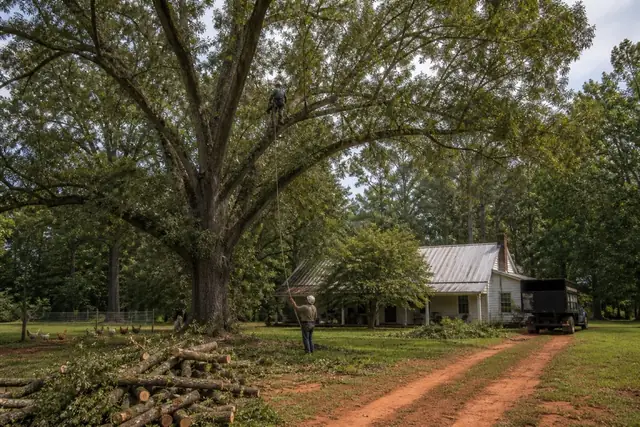
Macon Tree Experts connects Macon property owners with a local tree service provider for pecan tree care in Macon and nearby Middle Georgia communities.
Pecans are part of both urban yards and rural home sites across Middle Georgia. Their broad crowns provide high shade, but long limbs can become end-heavy, crowded trees compete for light, and nut production responds to water, soil, cultivar, and disease pressure. Tree care should distinguish safety and structure from expectations about the crop.
Pruning can remove deadwood, correct rubbing branches, or reduce a particular overextended limb. Wholesale thinning is not a substitute for scab management or irrigation, and topping creates large wounds and weak regrowth. Work around a bearing tree should also account for equipment access, falling nuts, nearby roofs, and the owner's harvest area.
Nutrition belongs to a soil- and leaf-informed plan. Zinc, pH, moisture, cultivar susceptibility, and alternate bearing can all influence performance. A sparse crop does not by itself prove the tree needs more fertilizer, and a healthy crop goal does not override structural risk near an occupied target.
Water and scab shape the home-tree conversation
UGA Extension's home pecan guide explains that pecans suit the Piedmont and Coastal Plain, need wide spacing, and can be limited by scab, insects, and water stress. It also separates backyard management from the intensive program used in commercial orchards.
The university's orchard site bulletin emphasizes deep, well-drained soil and the problems created by standing water. Those same drainage observations help explain why two yard pecans on one property can perform differently.
Do not prescribe from one season's crop
UGA's variety guide documents differences in scab response, maturity, nut quality, and alternate bearing. Identifying the cultivar may be difficult in an old yard tree, so recommendations should acknowledge uncertainty.
For nutrient questions, the UGA soil-sampling guide provides a repeatable starting point. Fertilizer should follow evidence from the root zone rather than a guess based on nut count alone.
Further reading
Before the quote visit
Why does my pecan produce heavily one year and lightly the next?
Alternate bearing is common in many pecans. Cultivar, crop load, water, nutrition, disease, and weather can all influence the swing between seasons.
Can a large pecan limb be shortened instead of removed?
Often, if it can be reduced to a suitable lateral without leaving a stub. Attachment, decay, end weight, and the rest of the crown determine the cut plan.
Does pruning cure pecan scab?
No. Airflow and removal of certain crowded or dead material may support management, but scab susceptibility and weather remain important. Excessive pruning creates other stress.
Should I fertilize a pecan that stopped producing nuts?
Test and diagnose first. Poor crop can relate to alternate bearing, shade, water, cultivar, disease, pollination, or nutrition, and added fertilizer may not address the cause.
How far should a pecan be from a house or power line?
Mature pecans become very large. Existing trees need target and clearance planning; new trees should be placed using mature canopy size, not their nursery size.