
Macon Tree Experts connects Macon property owners with a local tree service provider for tree cabling & bracing in Macon and nearby Middle Georgia communities.
Cables and braces can reduce movement at a specific weak union, but they do not make a defective tree failure-proof. The assessment should identify the part being supported, why it is vulnerable, what targets sit below it, and whether pruning can reduce load before hardware is considered.
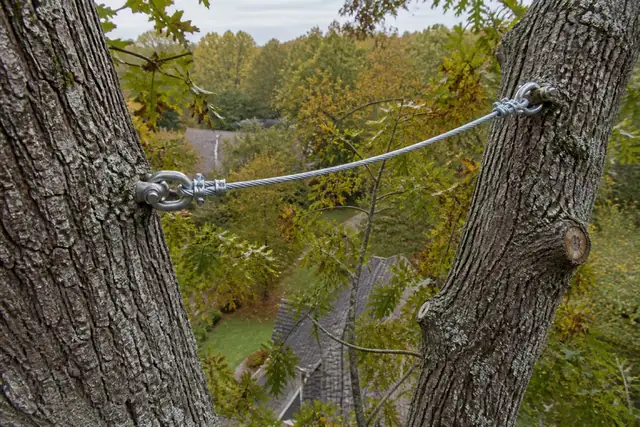
Cables are generally placed high enough to provide leverage between leaders or limbs. Bracing rods can limit separation through a split or weak junction. Hardware choice and placement depend on tree size, configuration, wood condition, and the type of movement being managed; a generic cable stretched between convenient branches is not a support design.
Support systems remain part of the tree after installation. Growth, corrosion, storm movement, and changes in crown weight can alter the system, so the owner needs a reinspection schedule and a record of where components were installed. Future pruning work should account for the hardware rather than discovering it with a saw.
Support begins with a structural question
UGA Extension's tree-care bulletin describes how branch attachment, pruning, and mature-tree condition interact. Before installing hardware, the provider should explain the defect, expected load change, and why removal or pruning alone is not the better response.
The Georgia Forestry Commission's care overview reinforces that maintenance is a sequence rather than a one-time device. Mulch, root-zone protection, and crown management can matter alongside supplemental support.
Weather changes load, not the guarantee
Wind, wet foliage, and ice add different forces to long limbs and co-dominant stems. The National Weather Service's Macon climate portal supplies official weather context, but a support system still needs tree-specific inspection after a significant event.
When choosing the person who designs and installs the system, use the Forestry Commission's tree-provider questions to ask about written scope, qualifications, references, and follow-up responsibility without treating the marketing brand as the practitioner.
Further reading
Before the quote visit
Can cabling save a tree with two main trunks?
It may reduce movement in some co-dominant unions, especially when paired with load-reduction pruning. Decay, an active split, root condition, and targets determine whether support is reasonable.
Is a cable visible from the ground?
Many systems sit high in the crown and are not prominent, but visibility is secondary to correct placement and access for future inspection.
How often should tree cables be checked?
The installation record should include a reinspection interval. Major storms, visible movement, new cracks, or substantial pruning can justify an earlier check.
Does cabling stop all branch movement?
No. Trees need normal movement, and support is designed to limit a particular displacement or share load. It cannot eliminate every failure mode.
Can old bolts or cables be removed?
Removal is not automatic because embedded hardware and the tree's response must be assessed. A new plan may retain, replace, supplement, or retire components based on current structure.