
Macon Tree Experts connects Macon property owners with a local tree service provider for dead & hazardous tree removal in Macon and nearby Middle Georgia communities.
A dead tree is not automatically the most urgent tree on a property, and a green tree is not automatically sound. Risk depends on both the likelihood of failure and what can be struck. A dead pine in an unused back corner presents a different decision from a cracked live oak over a bedroom, a school walk, or the only driveway exit.
The assessment should document observable conditions: recent lean, soil lifting, fungal structures, cavities, included bark, broken tops, dead crown percentage, construction root loss, or a history of limb shedding. Sounding, probing, aerial inspection, or other evaluation can add information, but no single symptom substitutes for looking at the whole tree and its targets.
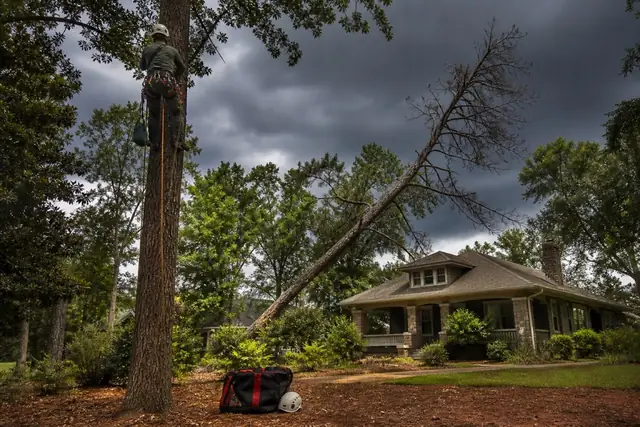
Removal methods also change when wood is brittle or hollow. Climbed dismantling may not be appropriate for a compromised stem; a lift, crane, changed rigging point, or exclusion zone may be needed. The written plan should explain the access and support method rather than treating a hazardous tree like routine pruning.
Risk is the tree plus the target
The Georgia Forestry Commission's tree-care information encourages informed evaluation rather than reflex cutting. Moving a play area or parking spot can sometimes reduce exposure while a tree is monitored or while work is scheduled.
Macon-Bibb's nuisance provisions address hazardous trees and obstructing vegetation in specific public-impact contexts. Private owners still need a site-specific evaluation; the code is not a diagnosis of every declining tree.
Decline can begin below the surface
UGA Extension's shade-tree care bulletin explains how compaction, grade changes, waterlogging, and root injury can mimic nutrient problems or accelerate decline. A history of trenching or construction around the tree is therefore part of the risk conversation.
When wind follows saturated soil, root anchorage deserves extra attention. The National Weather Service's Macon climate resources provide the official weather context, while the property inspection determines whether roots or trunk have actually moved.
Further reading
Before the quote visit
How can I tell whether a tree is hazardous?
Warning signs include new lean, lifted soil, cracks at major unions, large dead sections, cavities, root damage, and recently broken tops. Risk also depends on occupancy and targets beneath the tree.
Does a hollow trunk mean the tree must come down?
Not by itself. The amount and location of sound wood, crown load, species, defects, and targets all matter. A close evaluation is needed before choosing retention, reduction, support, or removal.
Why did my pine turn brown so quickly?
Rapid browning can follow root damage, drought stress, beetle activity, disease, or other causes. Diagnosis from color alone is unreliable, and dead pines can become brittle as time passes.
Can a dangerous limb be removed without taking the whole tree?
Often, when the defect is confined and the remaining structure can carry the revised crown. The cut size, attachment, decay, and resulting balance need to be assessed first.
Should I wait until winter to remove a hazardous tree?
A meaningful risk to people or occupied property should not be held to a cosmetic pruning calendar. Weather and access still affect scheduling, but hazard priority comes first.