
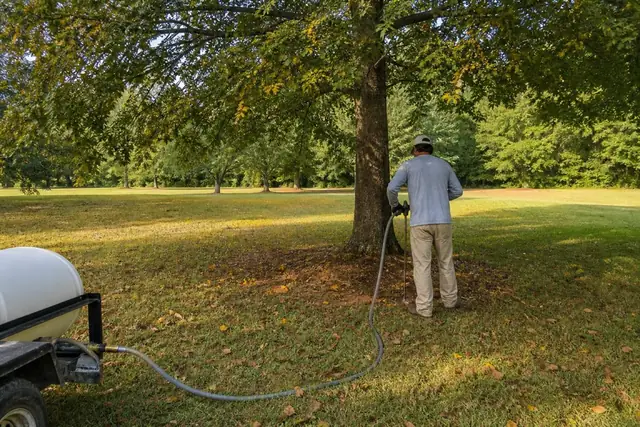
Macon Tree Experts connects Macon property owners with a local tree service provider for tree health & deep-root fertilization in Macon and nearby Middle Georgia communities.
Yellow leaves or sparse growth do not prove a tree needs fertilizer. Root cutting, compacted clay, fill soil, waterlogging, drought, planting depth, decay, and insects can create similar symptoms. A health visit should start with species, symptom pattern, site changes, drainage, mulch, irrigation, and the condition of both crown and root flare.
Soil testing can identify pH and nutrient conditions, while leaf or tissue analysis may help when symptoms remain unclear. Deep-root application is one delivery method, not a diagnosis. Adding nutrients without evidence can waste money, stimulate unsuitable growth, or leave the actual root problem untouched.
Middle Georgia sites often change sharply within one property: red clay on an exposed slope, disturbed builder fill near the house, and deeper alluvial soil toward a drainage line. Sampling zones should reflect those differences. Recommendations should state the material, rate, area, timing, and reason so follow-up can compare a real treatment with a real baseline.
Test first, then choose the treatment
UGA Extension's soil-testing guide explains representative sampling, including multiple spots around a tree's drip line. One scoop beside the trunk cannot describe a broad root zone or separate a wet pocket from an upland slope.
The university's shade-tree care bulletin warns that nutrient-like symptoms can come from girdling roots, compaction, water problems, disease, and other stresses. That is the reason diagnosis precedes an application.
Root-zone protection is part of health care
UGA's landscape best-practices publication notes that mature roots may spread far beyond the canopy and recommends soil testing as the basis for fertilization. Parking, trenching, or piling soil in that wider zone can outweigh a nutrient treatment.
The Georgia Forestry Commission's care guidance places watering, mulching, pruning, and monitoring beside professional treatment. The plan should address whichever stress is actually limiting the tree.
Further reading
Before the quote visit
Does every mature tree benefit from deep-root fertilization?
No. Trees in maintained landscapes may already receive nutrients, and many decline symptoms have non-nutrient causes. Testing and diagnosis should support the recommendation.
Why are the leaves on my oak turning yellow?
Possible causes include moisture imbalance, root injury, compaction, pH-related uptake, disease, pests, and nutrient shortage. The pattern, site history, soil, and root flare help narrow it.
How is soil sampled around a large tree?
Representative samples are taken from several locations in a defined root-zone area rather than one spot. Separate zones may be needed where slope, fill, drainage, or vegetation changes.
Can fertilizer repair construction damage to roots?
Fertilizer cannot replace severed or compacted roots. Care may focus on reducing further disturbance, correcting moisture or mulch problems, and monitoring crown response.
What should a tree-health recommendation include?
It should identify the observed problem, evidence used, proposed material or cultural change, treatment area, timing, expectations, and a follow-up point.