
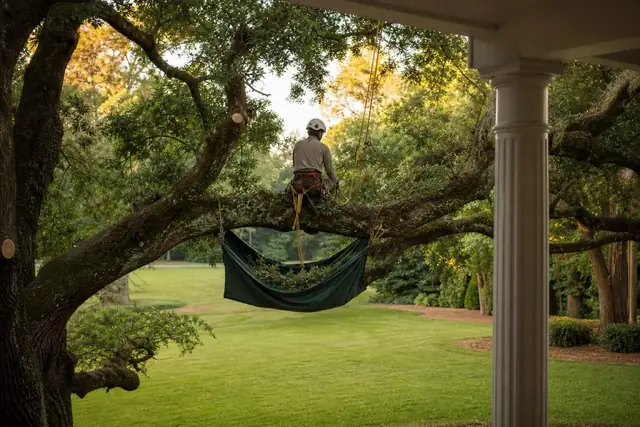
Macon Tree Experts connects Macon property owners with a local tree service provider for oak tree care in Macon and nearby Middle Georgia communities.
Macon's mature water, willow, southern red, and other oaks can define an entire lot. Their value also makes large, unnecessary cuts expensive in ways that are not visible on the invoice. Care starts by identifying the species and condition, then protecting the root zone and selecting only the pruning needed for structure, deadwood, or a specific target.
Older oaks often coexist with driveways, walks, porches, utilities, and altered grades. Surface roots are normal biology, not automatically a defect. Cutting them for pavement or trenching can reduce support and water uptake, while piling soil or mulch against the trunk can hide the root flare and trap moisture.
Crown work should respect how the tree carries weight. Reduction may shorten an overextended limb, cleaning may remove selected dead or broken branches, and cabling may be considered for a particular union. Broad thinning or stripping interior growth can expose remaining limbs and shift load to the ends.
Keep construction outside the working root zone
UGA Extension's landscape best-practices guide explains that mature roots can extend two or three times beyond the canopy. Tree-protection planning should therefore happen before excavation, material storage, or vehicle routes are fixed.
The university's shade-tree selection guide also connects mature size with buildings and underground structures. That context is useful when deciding whether to redesign a feature or impose repeated hard pruning on an existing oak.
Prune for a reason the tree can tolerate
UGA's tree-care bulletin shows proper branch-collar cuts and the staged removal of heavy limbs. On an old oak, limiting wound size and avoiding flush cuts are central parts of the scope.
The Georgia Forestry Commission's care resource gives owners a broader framework of water, mulch, pruning, and monitoring. A declining canopy should prompt diagnosis, not an automatic dose of fertilizer or a drastic trim.
Further reading
Before the quote visit
How should an old water oak be maintained?
Begin with condition and target assessment, preserve the root zone, remove selected dead or broken material, and reduce only limbs with a defined structural or clearance need. Avoid topping.
Are surface oak roots a sign the tree is failing?
No. Large woody roots naturally enlarge near the surface. New lifting, decay, severing, or soil movement may be concerns, but visible roots alone are common.
Can I add soil over exposed oak roots?
Deep fill can reduce oxygen and change drainage around roots. Small landscape adjustments may be possible, but major grade changes near a mature oak need careful planning.
Why is my oak dropping small branches?
Dead twig shedding can follow shading, drought, storm exposure, pests, or decline. Branch size, frequency, crown pattern, and site changes help determine whether it is routine or concerning.
Should ivy or vines be removed from an oak trunk?
Dense vines can hide the root flare and defects and add wind load. Removal should avoid bark injury and account for vines extending into the crown.