
Macon Tree Experts connects Macon property owners with a local tree service provider for lot & land tree clearing in Macon and nearby Middle Georgia communities.
Tree clearing begins with a boundary on the ground. Survey stakes, building envelope, access route, easements, buffers, septic areas, and trees marked to remain should be resolved before equipment enters the parcel. On a wooded Middle Georgia lot, a few feet of misunderstanding can remove shade that cannot be replaced on the project's schedule.
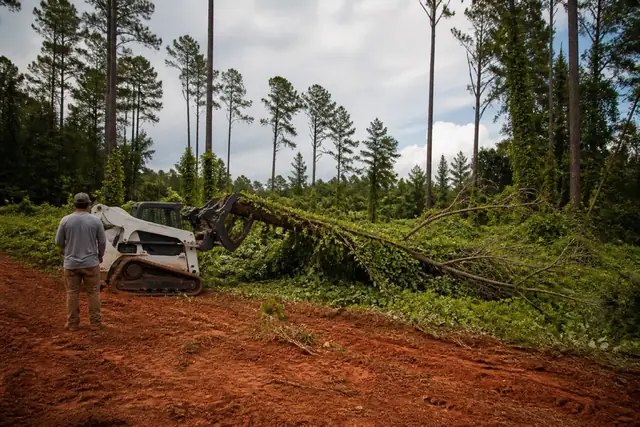
The method follows the end use. Selective clearing can open a homesite while retaining wind-firm groups and root protection; broader clearing may involve felling, grappling, chipping, hauling, stump removal, and rough grading. Wet red clay, vine-loaded edges, old wire, and hidden debris affect production and need to appear in the walk-through.
Clearing and site preparation overlap but are not the same scope. The tree quote should identify cut limits, stump treatment, disposal, merchantable material if any, and the condition in which the area is left. Drainage, erosion measures, final grading, and construction access should be coordinated with the other site trades rather than assumed.
Protect the trees that are meant to remain
UGA Extension's landscape best-practices guide notes that mature roots spread far beyond the trunk and often beyond the canopy. A protection line drawn at the bark offers little defense from compaction, trenching, or grade changes.
The Georgia Forestry Commission's tree-care resource supports evaluating retained trees before clearing. Trees abruptly exposed at a new edge may face changed wind and sun loads, so selection should consider the future stand, not only today's machine path.
Disturbance limits connect to water and utilities
Georgia EPD's storm-water program is the state source for construction runoff requirements. Project size and jurisdiction determine which controls apply, but keeping red clay on the site and out of drainage paths should be planned from the first equipment pass.
Before grubbing or stump excavation, use Georgia 811 and add private-facility information. Rural-looking acreage can still contain service lines, wells, septic fields, old fencing, and buried site infrastructure.
Before the quote visit
What should be marked before lot tree clearing starts?
Property and disturbance limits, access, easements, utilities, septic components, buffers, structures, and every tree or group to remain should be visible on the ground.
Can selected oaks and pines be kept during clearing?
Yes, when their condition, root zones, future exposure, and construction conflicts are evaluated early. Protection needs space for roots, not only a ribbon around the trunk.
Does tree clearing include stump removal and grading?
Only when listed. Felling, processing, haul-off, grinding, grubbing, rough grading, and final grading are separate operations that should be itemized.
What happens to brush and logs from a cleared lot?
Options include chipping, hauling, leaving specified wood, or other permitted handling. The proposal should identify the method and final site condition.
Can clearing continue when red clay is wet?
Sometimes limited work can continue, but traffic on saturated ground can create ruts, compaction, and runoff. A pause or changed access plan may protect both the site and retained roots.